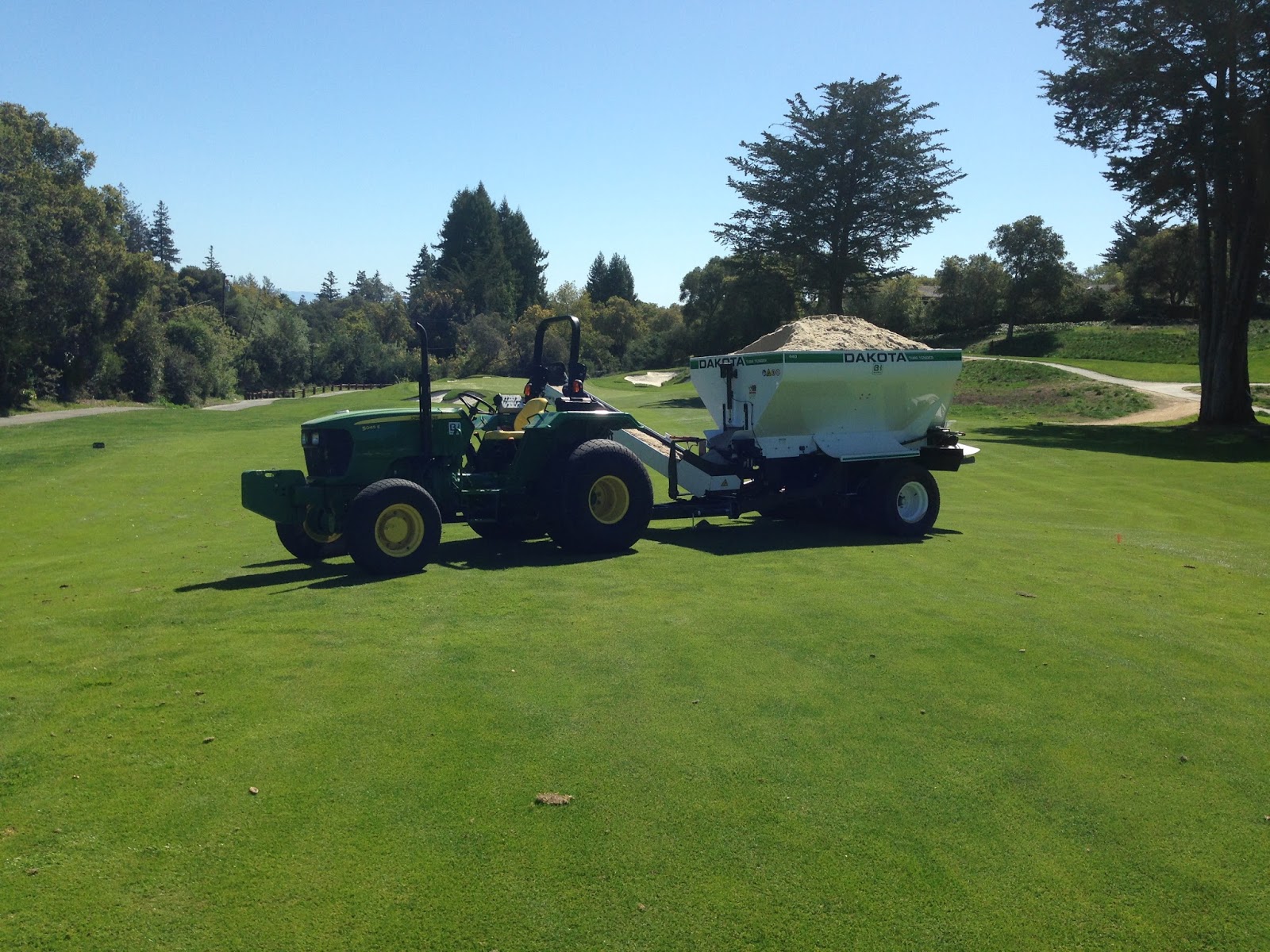
We are very proud to announce on 10/13/17 Pasatiempo Golf Club made recycled water for the first time. As a golf course superintendent, with almost 20 years in the business, I can say this project is something I am very proud to be associated with. Bogard Construction and SSA Landscape did a great job building and managing our project through record rainfall and challenging design changes.
We are now working our way through the system, fine tuning software and hardware issues. We will continue to operate the system and make water as needed until the rains take over.
Items Remaining to Complete:
The landscape irrigation is being installed this week with plant material onsite within the next 10 days
The restroom and cart path will open once we receive final inspection from the county
After all the contractors have completed their work the gold tee on #14 will be rebuilt
The old restroom on #15 tee will be removed
Valve opens for the first time
Secondary from Scotts Valley hits our pressurization vault
The water project has been moving at a blistering pace since the end of the winter rains. We are on track to finish construction mid August and begin our 2 week startup procedure. There are numerous requirements from the city, county and state before we turn on the treatment facility but the list is getting smaller each and every week.
Completed
500k gallon tank
All building foundations and walls
Pump station
Filters
Underground piping and electrical
In Progress
Finish work on all buildings
Above ground piping
Sewer connection
Finish grade
Landscaping
PG&E connection
Cart path
#14 gold tee
We are extremely excited about our current state of the water project. If you have any questions or would like to see the project up close please contact myself or Scott Hoyt.
After a long winter we are finally seeing significant progress around the storage tank. Building foundations are being poured today and underground utilities are underway. Above is an updated time-lapse of the tank site.
Scott Hoyt attended the Regional Water Control Board meeting in San Luis Obispo last week and received our recycled water permit. The permit to produce and distribute recycled water on property marks a significant milestone for this project and Pasatiempo.
Last week the City of Scotts Valley completed the diversion structure at the intersection of Graham Hill and Sims Road. The structure was needed to divert recycled water to our property. The city can now start construction of the new pipeline on Sims Road. The existing 6" pipe will be replaced with a 12" pipe from the intersection at Graham Hill Road to our property. The larger pipe is needed in order for us to receive the amount of water agreed to in the contract.
Please don't hesitate to contact Scott or myself with any questions.
I started a blog post last week about our near record rainfall season. As I revisit it this week our crew is hand watering greens after 4+ days of 70 degree weather. Predicting weather is a failed cause but I do hope we receive more rainfall this season. It's not because I want to break all the records or keep carts on the paths. I want a little more rain to make all the rain we received seem worth it. It doesn't really matter how much rain we get during the winter. It only matters when we get it. If we spread 30" evenly over 6 months it will conserve more water than 100" over 3 months. Sure, it helps replenish aquifers which is extremely important for many of our potable and agricultural needs within the county but, once the atmospheric river turns off it doesn't take long for us to be right back into irrigating. I would hate to see us pay a potable water bill over the next 60 days that increased almost 40% last October after 60" of rainfall.
So now back to our near record season. The chart below shows this year compared to the 5 wettest years in Santa Cruz since 1948. As you can see we are a few inches from a record season.
Just a reminder we will be closed for aeration April 10th-13th. Limited practice facilities will be open during aeration. Ken will send out a schedule as we get closer. Thank you for the positive comments about the golf course and as always if you have any questions or concerns please contact me or stop by my office.
The bulk of the pineapple express, atmospheric river or whatever else you want to call it is coming to an end. We faired well compared to several courses in the area. We received 5" of rain with very little damage. A medium sized pine tree fell along the ditch on #14 and a few small slides are visible along the barrancas. The bunkers should be back to normal by this weekend. Overall I feel like we dodged a bullet the past 48 hours.
To be honest, I had no expectations going into winter this year. Coming off a fairly wet El Nino (42") I was hoping for an average year of rainfall (30") spread out evenly October-April. Some of this had to do with the fact that as much as we needed the rain to replenish our water supply I selfishly wanted the winter to be mild so we could finish our water project on time. So far, it seems both are working in our favor.
The water project is still on time after picking up a few weeks during the construction of the tank. Our master schedule shows us back filling around the tank January 15th-February 1st. All we need is a 10 day stretch of no rain this month to complete.
We are also on pace for a very wet year. Our total rainfall since October 1st is 30" with a few more inches predicted over the next 48 hours. If we continue with average rainfall amounts over the next 90 days we could easily eclipse the 40" mark.
Since 1948 Annual Rainfall Totals
40"- 50" 10 times (last year being one of them)
50"- 60" 2 times
> 60" 1 (1997-1998)
Loch Lomond reservoir is over the spillway and the rivers and streams are at capacity.
You might think with all the rainfall the course would be almost unplayable. This couldn't be further from the truth. The significant investments in cart paths, drainage, bunkers, and top dressing are providing playable conditions throughout the winter. As I type this post we are mowing greens. The weekend looks clear and should make for a great round of golf.
We are very excited with the progress of the water project to this point. We are still on target to go online with the system June 2017.
Tank - We recently finished wrapping the tank with a large cable. For those of you who witnessed this it was very impressive. The cable is wound around the tank under tension and anchored in several places. The large red tower completed the wrap in less than 24 hours. Next week the cable will be covered with 6" of concrete. The tank will then be covered with a water barrier prior to back fill.
Backfill - We will begin backfilling the tank after the first of the year. The soil must meet specific moisture parameters in order for us to backfill and compact the soil around the tank. Several weeks ago we tested the soil and found it to be nearly perfect. We decided to cover the pile to maintain the moisture content which ended up being a great idea with all the rain. We estimate almost all of the spoils on #2 tee will be used to backfill the tank. Once completed the majority of the tank will be backfilled to the rim. The most exposed area will be on the northwest side of the tank facing #14 tee. Approximately 7' will be exposed on this side. The area will be screened by the bathroom and landscape.
Sewer - With the recent extension of the sewer system to Orchard Drive, along Sims Road adjacent to our project, we decided to modified our design to accommodate the new sewer connection. Access to the sewer will allow us to eliminate a septic field for our restroom and more importantly discharge our backwash from the recycled water filters into the sewer. The original design was to utilize the overflow line we installed along #14 to discharge the backwash back into the outfall line we receive our recycled water from. The original design would allow us to always receive the minimum daily amount of recycled water guaranteed in our contract from Scotts Valley (170k gallons). The quantity of backwash reintroduced into the outfall line (10k gallons/day) potentially limited us from taking all of the water flowing down the pipeline due to the permitted water quality the state mandates for discharge to the ocean. This is a huge win for us to now have the ability to take almost every drop of water in the outfall pipeline (up to 500k gallons/day) for the next 30 years. We negotiated the cost of the sewer connection to be applied to our property taxes over the 25-30 years.
Water Diversion - Part of our contract to receive the secondary water from Scotts Valley requires us to install a valve on Graham Hill Road to diver the water to Pasatiempo. The system was originally designed to divert water and included this valve. The valve was removed by the City of Scotts Valley many years ago. We are working closely Scotts Valley on several design options to divert the water to Pasatiempo.
The water project passed with overwhelming support from the shareholders. We all recognized the importance of securing alternative water sources at reasonable rates. This past October the City of Santa Cruz raised our potable water rates almost 40%. The increase was not known at the time of the shareholder vote. Without this project the known increases in potable water rates through 2020 would increase our annual potable water costs from 550k to 1.15 million.
Please contact Scott or myself if you have any questions. Thank you for the support and commitment to this project.
It will take approximately 20 weeks to complete the tank construction (2-1-17 projected completion)
All of the dirt that is being stored by the 2nd tee will be used as backfill against the tank.
All of the dirt that is being stored at the project location will be top soil for finish grade.
We applied hydromulch to all three piles to ensure they stay in place during the winter months.
We should complete the installation of the overflow pipeline right of the 14th hole and behind the green. The piles of sand behind the 14th green/15th tee will be used for backfill against the pipeline.
The overflow pipeline is mandated in our construction permit in case of emergency
It appears we will be tying into the new sewer system that recently got extended from Graham Hill road to Orchard drive on Sims road. We need to dispose of waste from our restroom but also backwash from our filtration station.The backwash was causing an issue that disposing of it into the sewer will resolve.
We have had our preliminary meetings with Scotts Valley and their engineers to come up with the best solution to divert the recycled water at Sims and Graham Hill to our plant. Scotts Valley will present to Pasatiempo 3 options for diversion and delivery by November 1st.
The projected completion date for the project is July 1, 2017
The water project is well underway. The excavation of the tank and pump station vault was completed this week. We were very fortunate not to find any significant ground water during the excavation. The spoils from the excavation will be stored below 2 tee until the tank is complete. Most of the spoils will return for backfill around the 1st of the year.
The next phase of the project will involve the construction of the pump station vault and storage tank foundation.
Pasatiempo funded the installation of a new irrigation
system in 2010.The new hardware and
software provides the latest technology in golf course water management.The irrigation decisions we make everyday
utilize weather station data, soil moisture meters and many years of
professional experience.The technology
we have available greatly decreases the need to hand water with hoses but will
never eliminate this most basic management practice.The last thing we want to do is overwater at
night and eliminate hand watering.Over watering decreases playability and increases disease pressure and
expenses.
Our greens are the most important surface on the golf
course.It only makes up 4 acres of our
entire property but demands the majority of our resources.In order for us to maintain expectations
moisture levels must be consistent throughout all of our greens.During the dry season we schedule 2 employees
every morning to hand water greens.We
target moisture percentages based on the weather and events for that day. In the afternoon we schedule 2-3 employees
with the same task.We do this 7 days a
week.The greens never take a day off
and neither do we.
One of our staff members was recently hit with a ball.I’ve witnessed severe injury from golfers hitting
into maintenance staff resulting in permanent disability.I know none of us wish this upon anyone.There will be times when you need to wait a
few minutes for an employee to finish watering a green during your round.We ask that you allow our staff to safely
finish their task before hitting.Thank
you for your support and understanding.
Spring aeration is almost complete and once again our maintenance staff pushed through some long days to keep us ahead of schedule. This year we added an additional procedure to the greens we believe will significantly benefit long term health and playability. The greens have developed a hard pan layer just below our aeration depth. Over time the layer will decrease water infiltration rates causing excess moisture to build up in the top layer of the profile. This can cause numerous issues including; soft conditions, anaerobic soils, decreased microbial populations, excess thatch and disease. The DryJect Maximus injects high pressure water into the green and fractures the soil at depths well below the layer. At the same time sand is drawn into the holes creating a pore space for air and water.
putting green 2 days after aeration 4/20/16
DryJect through the bottom of the soil profiler
The rest of our aeration schedule is similar to past aerations
Greens were aerated with 1/2" hollow tines, top dressed and fertilized
Fairways tees and approaches were aerated, seeded, top dress and fertilized
Traffic areas in the roughs were aerated, seeded, top dressed and fertilized.
first drag #4
DryJect #16
We utilize our 4 days of closure to perform tree maintenance around the golf course. This year we removed a dead pine between #1 and #9. Numerous cypress trees were pruned on #9, #10 and #17. We are now moving on to a few oak trees along #16 and will finish the week working on the oak trees in the parking lot next to the tennis courts.
We can't say enough about our mechanic Mario and what a great job he does. Another aeration with no major mechanical issues is significant for any operation.
If we want to be better this year we need to make changes in our program from the previous year. If we do the same thing every year and expect different results we will never reach our goals. We are confident the changes to our program this year will improve your experience on the golf course.
The winter of 2015-2016 was sold as the Godzilla of all El Nino's. We started off great with over 30" of rain. Our average annual rainfall since 1948 is 30" which we exceeded on January 30th of this year.
2015-2016
November 4.25"
December 9.45"
January 16.85"
Total 30.55"
Then we hit February and received 2 rain events totaling 1". So does this mean El Nino is a bust? Historically, El Nino typically produces significant rain during March and April.
1997-1998 8"
1982-1983 20.25"
1957-1958 15.35"
Average 14.5"
If we receive average rainfall for an El Nino season over the next 60 days we could approach 45" making this the 5th wettest year since 1948.
The golf course is dry and ready to soak up some much needed rain. The extended forecast looks promising with 4" of rainfall predicted over the next 7 days. Course conditions will still be favorable heading into the weekend. Dust off your rain gear and enjoy the golf course!
Our plan to receive secondary waste water from Scotts Valley Water treatment plan includes the use of a filter at Pasatiempo. The filter will treat the existing secondary water flowing down Graham Hill Road to tertiary water. Tertiary water is already approved in California for use on golf courses.
Our engineers advised renting the proposed filter and testing it at the treatment plant prior to construction of our onsite water facility. Last week several Pasatiempo maintenance workers under the direction of our assistant, Greg Ilacqua, successfully connected the filter to the treatment plant.
The test will take place over the next 30 days. During the test we will evaluate the amount of water, quality, maintenance, noise and smell of the filter operation. This data will be submitted as part of our Title 22 report to the Division of Drinking water and Regional Water Control Board. The data will also be used to determine the exact size of the filter needed, annual operational costs and design features around the filter area.
The area below #12 tee was hydroseeded this week. The seed blend is consistent with species currently in our native areas. If the current weather pattern continues we should expect some germination within the next 30 days. Additional erosion control measures will be installed across the hillside.
Once we complete the area below #12 tee we will continue to hydroseed other native areas around the golf course with poor turf coverage. Please avoid these areas during your round. The native grasses are extremely susceptible to injury due to the low seeding rates and slow germination.
As our invitationals come to a close our focus shifts to fall aeration. We will be closed for aeration September 28th to October 1st. The driving range, putting green and chipping green will reopen Wednesday for members.
Greens will be aerated with a 1/2" hollow tine, top-dressed and fertilized. Fairways will be aerated with a 7/8" hollow tine, seeded, top-dressed and fertilized. Tees and approaches will be aerated with a 5/8" hollow tine, seeded, top-dressed and fertilized. The first 30 to 50 yards we turned off this year to conserve water and weak traffic areas in the rough will be seeded, top-dressed and fertilized once we receive a few inches of precipitation.
We are often asked what we do on the golf course to produce tournament conditions. Many golfers believe we double cut and roll a few extra times, which is true, but much more goes into it. Everything we do on the golf course is part of a plan and building process. Hundreds if not thousands of decisions were made to produce the conditions you see today. It's not only about what we did yesterday or last week but years of planned cultural programs, timed fertilizers, growth regulator applications based on degree day models, monthly wetting agent sprays and judicious water management to produce the conditions we all enjoy. Aeration is and always will be the single biggest piece to our building process. We believe the earlier aeration this fall will allow the turf to heal faster and give the members great playing conditions during what is typically our best weather of the year.
None of this is possible without the support of the membership and resources to make it all happen. We thank you for your patience during this time.
Yesterday was the second of our four summer maintenance days. We use these days to perform cultural practices which would otherwise be impossible during normal play.
Maintenance Day Goals
Remove Thatch
Increase Air Movement
Push Water Through the Profile
Flush Salts and Bicarbonates
Order of Operations
Mow greens
Verti-cut greens ( thick slice for thatch removal )
Blow greens
Planet-Air (deep cut into the greens for air and water movement)
Roll greens
Top-Dress greens
Spray greens with wetting agent, fertilizers and other amendments to assist with flushing salts and bicarbonates
Apply more granular amendments
Water greens .2"
Water greens Overnight .35"
Planet Air
These procedures are vital to the health and playability of the golf course. We thank you for allowing these days and apologize for any inconvenience. The next maintenance day will be Monday, August 10th.
We recently sodded several areas around greens and tees. These areas look like drought stress but are actually dying due to a fungal disease. At any given time we attempt to control 20 different fungal diseases on the golf course. Fungi are always present waiting for the right host and environmental conditions to reproduce and continue their life cycle. The fungi we are seeing around these areas do not respond well to chemical controls. We sprayed several times before we experienced activity with little to no efficacy. Our plan is to control the pathogen by cutting out the sod and removing the top 2-3 inches of soil.
After nearly seven months of drilling and over a year of work, the test hole for the well on #12 is complete and at a depth of 1340'. The well was tested last week for potential output and water quality, with results indicating the potential to produce 100-200 gal/min from water sources above 800’. Below 800’ the test results indicate only limited amounts of brackish water. Such tests do not actually test the water; surrounding rock formations are tested and from that data potential output and water quality is calculated. Actual output and water quality cannot be quantified until we develop and utilize the well.
Possible Production
100 gal/minute pumping 24hrs/day will produce 144k gallons
200gal/minute pumping 24hrs/day will produce 288k gallons
We use an average of 300k gallons of water per day on the golf course, May-September
The information we have encourages us to complete the well to a depth of 800’, filling the hole below with concrete in order to prevent the brackish water from contaminating the usable water above 800’. As stated throughout this entire process the well is not an absolute and may go dry or not recharge itself at any given time.
We will not be able to utilize the well water or any other alternative source without a storage tank and a pump station. In order for us to develop such onsite infrastructure the Shareholders will need to approve the necessary funds. A detailed presentation of our options and a Shareholder vote are planned to take place within the next 90 days.
We appreciate your understanding during this process and look forward to completing the entire water project as soon as possible.
Every year during spring and fall aeration we remove all stakes, ropes and cart signs from the golf course. The improved visual impact on the golf course during this period is dramatic from all vantage points. We always try to limit the use of these tools but as the season goes on and compaction increases we tend to expand their use.
The stakes, ropes and cart signs take up a significant amount of labor and resources. We not only move them to divert traffic but we also move them everytime we mow these areas. The rope is replaced several times a year and the cart signs are removed 3-4 times a year and pressure washed.
During a recent green committee meeting several ideas were proposed from experiences on other golf courses. After discussing the ideas with Pasatiempo staff, board and committee members we decided to change how we direct traffic throughout the property.
Starting today you will see a 3' tall wood stake at the beginning and end of each hole. Please take a moment to read the new cart policy below.
Drive on the cart path as far as possible past the first stake
Exit the cart path using the 90 degree rule and proceed to your ball
When off the cart path utilize the fairway as your primary driving area and avoid driving through the rough when possible
Exit before the last stake back to the cart path
Never drive through native areas or on designated walking paths
The stakes will only be successful with your participation. Ken and his staff will do a great job getting the word out to members and guest in the pro shop and on the first tee. We are treating this as a trial period and welcome input from the membership. Please contact myself, Ken or Scott with any questions.
Spring aeration is finally here. The crew stepped up and put in a full 13 hour day yesterday. We were able to finish all the greens and the front nine fairways. We had no mechanical issues yesterday which is unusual for an aeration. This can be directly attributed to the investment the club has made in new equipment and the great job our service manager Mario does everyday. We understand this week is an inconvenience to the membership. We appreciate your understanding during this important and necessary process.